[Note: This is somewhat old news by now, but it is still worth reporting.]
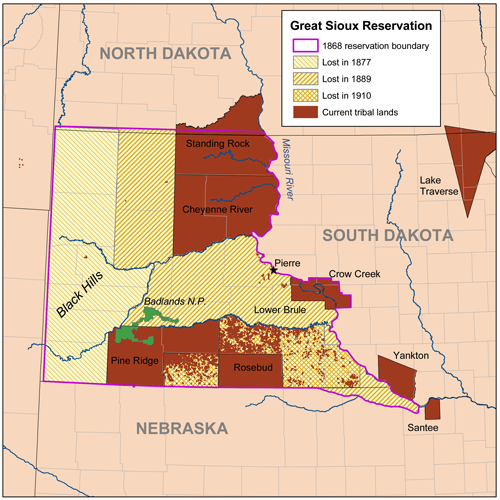
A South Dakota tribe has “banned” the Republican governor Kristi Noem from the Pine Ridge Indian Reservation after she spoke about wanting to send razor wire and security personnel to Texas to help deter the illegal immigration and crime that is crossing the border of the U.S., as this article explains.
I think the leaders of such tribes are told by the political Establishment to make such statements, presumably through them most likely being Freemasons. (link, link, and link)
I doubt a lot of members of those tribes actually share such beliefs that their leaders are espousing, or at least I don’t think they would if they were better informed about the matter.
What I think makes the statement of the tribe leader particularly ridiculous is the fact that he is “enforcing the border” of his reservation in response to what she said. Does his open borders philosophy for the U.S. mean that he also thinks the borders of his reservation don’t have any meaning and anyone can move and live there, including white people?
To me the mentalities of such leaders have a lot of similarities with the corrupt and dishonest Black Lives Matter organization, as this link explains, and in fact it is almost certainly being directed by the same global elite.
I do think native Americans have a legitimate grievance with sports teams using native American imagery however, and such teams should be renamed— but aside from such cultural appropriation I can’t really think of other modern grievances that are “on the surface” in such a manner, although the political Establishment has been harming them in many other ways as I’m explaining in this article.
This John Stossel video explains the situation of Indian Reservations in the U.S., where native Americans are in the process of being turned into Communists.
The configuration of the United States being a Democratically Elected Constitutional Republic is the best and the most fair government in the world, as the videos on this article explain, and the global elite is in the process of attempting to destroy that in order to usher in their planned Communist New World Order. (link)
In this video Vincent James explains an article posted on the website of the speaker of the House Mike Johnson that details all of the times Joe Biden had undermined Border Security during his administration. In the video James also shows leaked footage of a migrant “processing room” at the Atlanta airport.
Following is the full text of the article on Johnson’s website:
WASHINGTON — Last week, in a weak attempt to shift blame for a crisis their own policies created, the White House clumsily tried claim that House Republicans had an “anti-border security record” by voting to “eliminate over 2,000 border patrol agents and erode our capacity to seize fentanyl.”
These claims were demonstrably untrue, previously disproven, and underscored the Biden Administration’s failure to secure our southern border, marked by record high crossings in December and widespread national recognition that the situation at our border is a crisis.
“Since his first day in office, President Biden and his administration have worked to systematically undermine America’s border security,” Speaker Johnson said. “On more than 60 occasions, he has manipulated the federal bureaucracy to open our borders to illegal immigrants, human trafficking, fentanyl, and potential terrorists. The result is a humanitarian and national security catastrophe. The President must use his executive authority to repair what he has broken. I am calling on him to do so. “
Below are 64 instances of the Biden Administration undermining border security policy and encouraging illegal immigration. Click here to download this document with source links and corresponding data on encounters, number of children smuggled, and fentanyl seized.
[NOTE— I have added the highlighting and capitalization to the following list.]
— Jan 20, 2021: President Biden terminated the National Emergency at the Southwest border (Proclamation 9844), thereby HALTING EMERGENCY CONSTRUCTION OF A BORDER WALL.
— Jan 20, 2021: President Biden issued an Executive Order (EO) further entrenching the unlawful Deferred Action for Childhood Arrivals (DACA) program. With his action, President Biden directed the Secretary of Homeland Security, in consultation with the Attorney General, “to preserve and fortify DACA”, signaling to illegal aliens that HIS ADMINISTRATION SUPPORTS AMNESTY and that illegal aliens need not fear coming to the U.S. or worry about immigration enforcement.
— Jan 20, 2021: President Biden unveiled the U.S. Citizenship Act, which would PROVIDE AMNESTY TO MILLIONS OF ILLEGAL ALIENS IN THE U.S., demonstrating intent to reward illegal border crossers with a path to citizenship.
— Jan 20, 2021: President Biden revoked Trump-era Executive Order that was designed to ensure there was meaningful enforcement of U.S. immigration laws.
— Jan 20, 2021: The Administration issued an Executive action ENDING LIMITATIONS AND RESTRICTIONS AGAINST IMMIGRATION FROM CERTAIN COUNTRIES ASSOCIATED WITH TERRORISM.
— Jan 20, 2021: The Biden Administration announced a 100-day moratorium on deportations and immigration enforcement, effectively providing amnesty to criminal and other removable aliens and sending the signal the Biden Administration would not enforce the law. The Administration also announced interim immigration enforcement guidelines that signaled to illegal aliens that they do not have to worry about the possibility of deportation.
— Feb 1, 2021: The Department of Homeland Security (DHS) implemented Acting Secretary Pekoske’s policy requiring a new “process [that] shall provide for assessments of alternatives to removal including, but not limited to, staying or reopening cases, alternative forms of detention, custodial detention, whether to grant temporary deferred action, or other appropriate action.”
— Feb 2, 2021: President Biden issued Executive Order (EO) 14010 and began processing asylum claims at the border. In the EO, the President also signaled an END TO THE MIGRANT PROTECTION PROTOCOLS (which is known as “Remain in Mexico” or “MPP”) while making other statements signaling an open border.
— Feb 6, 2021: Secretary of State Antony Blinken suspended, and began termination procedures, for the Trump Administration’s Asylum Cooperative Agreements with El Salvador, Guatemala, and Honduras. These agreements ensured aliens seeking asylum could do so in countries closer to their home country and in countries other than the United States.
— Feb 2021: The Biden Administration voluntarily stopped applying Title 42 expulsions to children across the board, SETTING OFF A MAJOR WAVE OF UNACCOMPANIED ALIEN CHILDREN, FAMILY UNITS, AND ILLEGAL ALIENS GENERALLY HEADING TO THE U.S. BORDER.
— Feb 17, 2021: The Centers for Disease Control and Prevention (CDC) exempted unaccompanied alien children (UAC) from Title 42 expulsion requirements, thereby encouraging UACs to come to the U.S. and PARENTS TO PAY CARTELS TO SMUGGLE THEIR CHILDREN TO THE U.S. BORDER.
— Feb 25, 2021: The Biden Administration sped up releases of UACs.
— Mar 2, 2021: According to news reports, THE BIDEN ADMINISTRATION LOST TRACK OF 20,000 UNACCOMPANIED ALIEN CHILDREN and President Biden was briefed on the need to expand detention to hold an additional 20,000 children who had illegally crossed the border.
— Mar 5, 2021: Faced with overwhelming numbers of UACs in federal custody, the CDC ignored its normal facilities guidance regarding COVID-19 and notifies “facilities caring for migrant children that they can open back up to pre-Covid-19 levels, acknowledging ‘extraordinary circumstances.’”
— Mar 10, 2021: Biden Administration announced reinstatement of the Central American Minors (CAM) program, an Obama-era parole program that allowed citizens and aliens—including illegal aliens—to bypass the family-based immigration laws adopted by Congress and sponsor family members El Salvador, Guatemala, and Honduras to come to the United States.
— Mar 16, 2021: DHS Secretary Mayorkas delivered remarks effectively explaining the border is open for illegal immigration by STATING DHS’S FOCUS WOULD BE ON “PROCESSING” ILLEGAL ALIENS—IN OTHER WORDS CATCH-AND-RELEASE AND THE CREATION OF NEW “LAWFUL PATHWAYS.”
— Mar 20, 2021: DHS began issuing illegal alien border crossers a Notice to Report (NTR) to U.S. Immigration and Customs Enforcement, as opposed to the standard Notice to Appear (NTA) in U.S. immigration court. THE NTR POLICY ALLOWS ILLEGAL ALIENS TO SIMPLY BE RELEASED INTO THE U.S. AND RELIES ON THEM TO SELF-REPORT TO ICE AT A LATER DATE.
— Mar 30, 2021: Office of Refugee Resettlement (ORR) took drastic actions to expand detention space to house unaccompanied alien children in so-called “Influx Care Facilities”, often using unlicensed facilities that lacked child welfare experience. In March, April, and May of 2021, ORR expanded capacity to house another 23,849, including 10,000 at Fort Bliss. DHS was also holding children for a longer period than allowed by law (between 30 and 40 days) and, because the flow of UACs across the border outpaced Health and Human Services’ (HHS) ability to vet adults who can care for the children.
— Mar 31, 2021: The Department of Health and Human Services (HHS) Office of Refugee Resettlement (ORR) issued guidance rolling back requirements for background checks on adults in the household of a UAC sponsor.
— Apr 30, 2021: The Biden Administration canceled further wall construction which was being led by the Department of Defense (DOD).
— June 15, 2021: The Biden Administration announced expansion of the Central American Minors (CAM) program to broaden the list of illegal aliens who can sponsor family members through the program, including illegal aliens who claim asylum.
— June 16, 2021: Attorney General Merrick Garland rescinded the Trump-era decision In Matter of L-E-A-, thereby expanding asylum eligibility to allow nuclear or immediate familial relationships to be treated as a “particular social group.”
— June 16, 2021: Attorney General Merrick Garland rescinded the Trump-era decision in Matter of A-B I and A-B II, thereby expanding asylum eligibility to include gender and domestic relationships as certain social groups, reverting to policy under in Matter of A-R-C-G.
— July 2021: The United States Border Patrol (USBP or BP) released at least 50,000 aliens without giving them a “Notice to Appear” (a court date), instead advising them to self-report to ICE on their own. Unsurprisingly, 87% of aliens fail to report.
— Aug 5, 2021: The USBP authorized the use of parole plus alternatives to detention (ATD) in the Del Rio Border Sector.
— Aug 17, 2021: DHS announced an expansion of alternatives to detention (effectively reinstating and expanding catch and release) and announced the expansion of taxpayer-funded services to illegal aliens in removal proceedings.
— Aug 31, 2021: The Biden administration released over 100,000 aliens into the United States between March 21, 2021 and August 31, 2021, without giving these aliens a “Notice to Appear”, instead advising them to self-report to ICE on their own. Of those, nearly 50% of them did not check-in with ICE within the 60-day deadline.
— Sep 24, 2021: THE ADMINISTRATION FALSELY ACCUSED BORDER PATROL AGENTS ON HORSEBACK IN DEL RIO, TEXAS OF WHIPPING ALIENS AT THE BORDER. President Biden condemned the agents, saying the aliens had been “strapped” and vowed “consequences.” Vice President Harris piled on the false allegations, comparing them to oppression and slavery. In fact, DHS Secretary Mayorkas knew the claim was false and even though the agents were exonerated in July 2022, the Administration proposed punishment for the agents.
— Sep 30, 2021: DHS Secretary Mayorkas issued a memorandum that states “the fact an individual is a removeable [alien] should [not be the sole] basis of an enforcement action”, effectively using prosecutorial discretion to give deportable aliens a pass to stay in the United States, thereby granting a form of amnesty to many illegal aliens.
— Fiscal Year 2021: Throughout Fiscal Year 2021, the Biden Administration distributed more than $300 million in federal law enforcement grants to Sanctuary Cities under SCAAP, Byrne, and COPS programs (amounting to 43% of total awards going to sanctuary cities), financially rewarding cities whose policies encourage illegal immigration.
— Oct 8, 2021: DHS canceled another group of border wall contracts led by DHS related to the Laredo and Rio Grande Valley Border Sectors.
— Oct 12, 2021: DHS effectively suspended large-scale worksite enforcement, a key tool to deter the hiring and employment of illegal aliens.
— Oct 27, 2021: DHS Secretary Mayorkas issued a memorandum PROHIBITING ENFORCEMENT OF IMMIGRATION LAWS in certain areas including schools, healthcare facilities, recreational areas, social service and emergency facilities, ceremonial locations (such as funerals and civil ceremonies) as well as at demonstrations and rallies.
— Oct 29, 2021: DHS Secretary Mayorkas terminated the Migrant Protection Protocols(known as “MPP” or “Remain in Mexico”).
— Nov 2021: The Biden Administration formally created a program that included alternatives to detention (ATD) plus parole, RESULTING IN “CATCH AND RELEASE” for hundreds of thousands of aliens into the U.S. interior after they were encountered at the border (338,000 aliens were released in Fiscal Year 2022 alone) under this program.
— Dec 17, 2021: Immigrations and Customs Enforcement (ICE) repurposed three detention centers previously used for family detention, thus encouraging greater illegal immigration of family units.
— Jan 2022: Between July 2021 and January 2022, the United States admitted more than 79,000 AFGHAN EVACUEES as part of Operation Allies Welcome after the Biden State Department and Department of Defense botched the nation’s withdraw from Afghanistan. The DHS OIG determined that DHS FAILED TO FULLY VET THE EVACUEES. Failure to vet refugees, signaled that the Administration might also apply lax vetting to asylum seekers, further encouraging asylum abuse.
— Apr 1, 2022: The Biden Administration announced intent to end Title 42. Federal District Court Judge from Louisiana temporarily blocks the action.
— Apr 3, 2022: ICE Principal Legal Advisor issued memorandum promoting termination of cases in immigration court and directing ICE Office of the Principal Legal Advisor (OPLA) trial attorneys to comb through their cases to determine whether aliens would be considered a “priority” for removal under the Biden “enforcement priorities.”
— Sep 9, 2022: The Biden Administration reversed Trump-era public charge rule, allowing aliens who are likely to become a burden to taxpayers to receive immigration benefits – such as a visa, admission, or adjustment of status.
— Oct 31, 2022: DHS finalized a rule to “fortify DACA”, which declares DACA recipients as “lawfully present” and grants them employment documents despite ongoing litigation.
— Dec 13, 2022: The Biden Department of Justice (DOJ) sued the State of Arizona in order to force Arizona to remove shipping containers placed to close gaps in the border wall.
— Jan 2023: CBP changed CBP One app to allow border crossers to schedule online appointments, expanding the number of aliens allowed into the United States.
— Jan 6, 2023: The Biden Administration began abusing statutory parole authority under INA 212(d)(5) by creating a categorical parole program for nationals of Cuba, Haiti, Nicaragua, and Venezuela. Parole was intended by Congress to be used sparingly and only on a “case by case” basis, yet DHS continues to create and administer categorical parole programs to allow hundreds of thousands of illegal aliens to classes of aliens.
— Feb 25, 2023: The New York Times reported data showing the Biden Department of HHS has LOST TRACK OF 85,000 ALIEN CHILDREN OVER THE PRIOR TWO YEARS. NYT exposes details of minor children working in factories in the United States.
— Mar 2023: ICE continued to ignore the need for deportations, allowing criminal aliens to stay in the U.S. ICE’s non-detained docket grew to an estimated 5.3 million aliens, including 407,983 criminal aliens. Meanwhile, ICE arrests in Fiscal Year 2022 fell by 69% compared to Fiscal Year 2018 and arrests of convicted criminals fell 65% (to 36,322 in Fiscal Year 2022 from 105,140 in Fiscal Year 2018).
— Mar 25, 2023: Despite record numbers of illegal aliens arriving at the southern border, the Biden Administration proposed cutting detention beds by 25 percent as part of its Fiscal Year 2024 budget request.
— Mar 28, 2023: DHS Inspector General (IG), citing lax oversight, issued a report that identified misuse and fraud of federal emergency funds, resulting in up to $110 million in funds appropriated in the American Rescue Plan and other legislation being awarded to pay for services to illegal aliens and not Americans suffering due to COVID.
— Apr 13, 2023: The Biden Administration announced DACA recipients would be eligible for Obamacare benefits and Medicaid, giving taxpayer-funded healthcare to illegal aliens.
— Apr 27, 2023: The State Department and DHS announced plans to end Title 42, expand CBP One app, and create additional unlawful categorical parole programs for aliens from El Salvador, Guatemala, Honduras and Colombia. The program violates the law and allows aliens to enter before they receive a green card and without a visa.
— Apr 30, 2023: The Biden Administration circulated guidance that waters down the vetting process for Chinese illegal aliens, requiring that interviews used to question a Chinese illegal alien consist of five basic questions. The media reported that Chinese illegal aliens “quickly adapted” to the new CBP guidelines and were “coached” to give “stories that are identical.”
— May 5, 2023: CBP expanded appointment capability of the CBP One App. Through Nov. 2023, nearly 360,000 appointments had been scheduled on the app (43,000 in November alone). The CBP One app continues to be vulnerable to exploitation by the cartels.
— May 11, 2023: The Biden Administration terminated use of Title 42 policy expulsion authority.
— May 31, 2023: The Biden Administration ENDED THE DNA TESTING PROGRAM USED TO VERIFY THAT ADULTS WHO CROSSED THE BORDER WITH A CHILD AND CLAIMED TO BE RELATED TO THAT CHILD, ARE IN FACT RELATED. Ending the program promotes not only illegal immigration, but also child exploitation and trafficking.
— July 7, 2023: The Biden Administration expanded unlawful parole programs to include individuals from Colombia, El Salvador, Guatemala, and Honduras.
— July 24, 2023: The Biden Department of Justice sued the State of Texas to remove newly placed floating barriers in the Rio Grande River.
— Aug 10, 2023: The Biden Administration Office of Management and Budget requested nearly $14 billion in emergency funding that perpetuates the Biden Administration’s open borders policies. For example, $600 million was requested for FEMA’s Shelter and Services program, which provided airfare and hotels to illegal aliens. This is on top of the $363.8 spent by the program in Fiscal Year 2023.
— Aug 29, 2023: ICE scrambled after releasing into the U.S. more than a dozen Uzbek nationals with ties to an ISIS smuggler.
— Aug 2023: DHS rebranded “Alternatives to Detention” as “Release and Reporting Management,” effectively using ICE to provide social services to aliens instead of allowing ICE to function as a law enforcement agency.
— Sep 8, 2023: The Biden Administration promulgated a proposed rule to reverse Trump-era policy and allow Immigration Judges to administratively close or dismiss removal proceedings without any action (something not allowed by statute), resulting in no decision denying asylum.
— Oct 4, 2023: The Biden Administration issued new rules on UACs that FAILS TO PREVENT THE RELEASE OF ILLEGAL ALIEN CHILDREN TO STRANGERS, FAILS TO FACILITATE AGE DETERMINATIONS, and fails to collect immigration information on sponsors. All of this will encourage trafficking of children, including by the cartels.
— Dec 21, 2023: Biden Administration announced the creation of a new “juvenile” docket within immigration courts which is so expansive, it gives specialized treatment to 18, 19, and 20 year-old illegal aliens who should be deported through the expedited removal process.
— Dec 28, 2023: Following a trip to Mexico by Secretary of State Blinken and DHS Secretary Mayorkas, the Mexican government reported that their discussions focused on “regularizing” status – i.e., amnesty – for “Hispanic migrants who have been undocumented… and DACA beneficiaries.”
— Jan 3, 2024: The Biden Administration sued the State of Texas for enforcing a recently enacted Texas state law that allow Texas judges and magistrates to order illegal aliens to return to the foreign nation from which they entered.
In this video, Alex Jones explains issues with the upcoming border security bill, explaining that it will end U.S. sovereignty, give Biden dictatorial powers, give $2.3 billion to NGO human traffickers who are facilitating bringing the migrants, give $60 billion to Ukraine, give $14.1 billion to Israel, and give legal status to to millions of illegal immigrants, among other issues.
Following is a summary of this article by Raymond Ibrahim:
Germany’s top domestic intelligence chief from 2012 to 2018 Hans-Georg Maaßen said in a recent interview that “Europeans will succumb to Islam,” where the ideology is projected to take over Europe within the next few decades due to the radical demographic changes that are occurring.
According to conservative estimates from Pew Research, Europe’s Muslim population will triple over the next 25 years to be 76 million. However the actual current and future numbers are likely even much higher. For example, an earlier 2011 Pew Research study has found: “The number of Muslims in Europe has grown from 29.6 million in 1990 to 44.1 million in 2010. Europe’s Muslim population is projected to exceed 58 million by 2030.”— Therefore 58 million Muslims five years from now is much larger than than 76 million in 25 year’s time.
Islam’s rapid growth in Europe is due to out of control mass migration that has been occurring, but also due to the fact that average Muslim women have significantly more children than average European women. The name “Muhammad” is the most popular name for newborn boys in Europe.
In the interview, Hans-Georg Maaßen explained that what is happening is intentional on the part of Europe’s ruling elite:
[O]ur politicians want a different population. The political left follows the course of the anti-German ideology. The more heterogeneous a population, the less able it is to articulate itself and have a democratic say. The more politics accept immigrants from other countries as they see fit and grants them citizenship, the more politics select the people of the state and influence the election results. These migrants then vote differently than the locals.
He explained that it would be easy for the European governments, especially Germany and Austria, to put a stop to the out of control immigration that is happening in those countries, but they refuse to do it.
He cites a recent “migration summit” in Germany, that was a “show summit” which focused only on how to raise more money for asylum seekers and for asylum procedures, where nobody focused on the question of, “Why are we letting these people into Germany and Europe in the first place?”
Every European city that has a significant migrant presence has become full of violent criminal activity. For example, even back in 2017 an article entitled “Austrians living in fear as violent migrant gangs carry out DAILY attacks in Vienna,” reported:
Muggings and beatings are becoming commonplace in the historic capital city, with passersby being attacked on almost a daily basis…. The Praterstern area, just outside central Vienna, is now controlled by North Africans and is considered the worst area in the city for crime. Despite police increasing their presence in the area it has become riddled with crime. On the other side of the city, the area surrounding the West Railway Station has been taken over by Afghans who have been making headlines for all the wrong reasons…. Crimes carried out by migrants in Austria have risen rapidly over the past year as more arrive in the country. Last year [2016], there were a total 22,000 criminal complaints against migrants, up from 14,000 in 2015, the Austrian Interior Ministry revealed. Sex attacks carried out by asylum seekers has become a serious problem in Austria, with a 133 per cent increase in migrant sex attacks in the past year since the migrant crisis erupted. Swimming pools and other public venues have become some of the most prevalent areas for attacks to take place.
After rioting recently occurred in Ireland in response to an attack by a Muslim who stabbed three small children and their caretaker (link), Ireland responded by heavily curtailing free speech (link). Also Denmark is now forbidding mockery of Islam despite the fact that it had always allowed mockery of Christianity under “freedom of expression.”
Maaßen explains that the unchecked migration is happening because Europeans have no motivation to eject their traitorous leaders:
We don’t know where we want to go. What should Germany or Austria look like in 2030? We are living only in the moment, and therefore we are losing out to others who have a religion or ideology, who know where they want to go. We lack a mission… Mostly Muslims come to us with a completely different awareness of culture, religion and family. In secular Europe, religion and family — if they are still important at all — are a matter for the individual, but in these cultures it is a matter for the clan.
…
Europeans will succumb to Islam. On the one hand, because they are unable to even see this conflict coming, and on the other, because they are incapable of resolving conflicts in a similar fashion.
… [W]e’re incapable of resolving conflicts even by means of violence, like family clans do from the Arab states. These people resolve conflicts by violence, whereas people in Central Europe think that this can only be done through the courts.
Maaßen is saying that most Western people are so accustomed to believing that the “rule of law” still exists that they are simply waiting and expecting their authorities to fix the problems, which will not happen— whereas many incoming Muslims are accustomed to needing to resolve conflicts using hostility due to being acclimated to the dysfunctional situations in their originating countries. The sooner that Europeans realize this is the case, the better. Otherwise, the end result will be the destruction of the European culture.
[Note: I believe that the use of the system of the rule of law can be fixed if enough people become more informed about the little-understood corrupt aspects of the system.Also see the videos on the bottom of this article that explain problems of Islamization that is happening in Europe.]
Netflix has created a new documentary series about the Alexander The Great, however in it they are attempting to depict him as being a homosexual, despite the fact that there is no proof of that. Oliver Stone also falsely attempted to portray him that way in 2004.
Alexander The Great was a Greek king who subjugated Persia for Greece while he was in his 20’s. In his ten year campaign in Persia he won many initial battles due to courage and good strategy, leading to many areas such as Babylon and Egypt then welcoming him as a liberator without a fight, where Egypt even made him a Pharaoh. He was the last significant king of Greece, and he was given the title “The Great” by the later Romans who admired his accomplishments.
“Historians” who are claiming that he was a homosexual are making that assumption without any proof— where they are ridiculously reasoning: “Back then everyone was gay in Greece, so therefore he must have been as well.” Such reasoning can be seen in this Daily Mail article about the Netflix series that even claims in its title that “historians [say he] had relationships with men.”
When I was making the “History of the World article,” I kept seeing videos about Greek history which said that homosexuality was “compulsory” in ancient Greece— and I knew that there was no way that could be true, so after searching the internet about the matter I found the excellent book “Homosexuality in Ancient Greece: The Myth is Collapsing”, which details much evidence showing that homosexuality was generally not accepted, let alone “ideal” in ancient Greece. I summarized the book at this link, which is included in the section about Greece in the History of the World article. The book has an entire chapter that debunks claims about Alexander The Great being a homosexual.
MUCH PREFERABLE VIDEOS ABOUT ALEXANDER THE GREAT
This video on the “Epic History TV channel” details Alexander the Great’s conquests of all of Persia between 334 BC and his early death in 323 BC at age 32. The video makes use of detailed computer simulations that depict the strategies and situations of key battles. It explains his long string of victories over a period of ten years due to his effective strategies and courage as a general, as well has how the newly acquired lands immediately fragmented into empires that fought with each other for power after his death, with most of the regions ultimately being subjugated by Rome a few hundred years later.
[Note: This interesting video starts by explaining background information about the situation of Greece at the time, and then it details Alexander’s conquests starting at about 5:00 using computer simulations. I recommend watching it.]
This well-made German ZDF documentary details the life of Alexander the Great. The documentary is dubbed in English.
Video: “Alexander the Great” (ZDF documentary) Episode 1 of 2: The Path To Power
This episode details the early life of Alexander the Great, where he grew up being trained as a warrior, tutored by Aristotle, and expecting to one day be the king of his province. Alexander’s kingdom of Macedonia was initially thought of as being somewhat of a “backwater” area before Alexander took control of most of Greece and embarked on his ambitious campaign of conquering Persia.
“Alexander the Great” (ZDF documentary) Episode 2 of 2: Until the End of the World
This second episode explains Alexander the Great’s ambitious conquest of Persia, where he won key battles due to courage and good strategy, leading to many regions of the area such as Babylon and Egypt then welcoming him as a liberator without a fight.
He was the last great leader of Greece, and his death resulted in the fragmentation of the newly subjugated lands of Persia, followed by Rome eventually taking power in the region a few centuries later.
Ancient Assassins – Alexander the Great’s Spidermen
This interesting video explains a siege that Alexander engaged in during his conquest of Persia, where his soldiers scaled the face of a dangerous steep cliff over a period of a few days in order to surprise the enemy that was camped out on top. [Note this video is not yet on the History of the World article.]
This documentary details the Nordic Bronze Age that existed in a time period between 1,800 BC—500 BC, also explaining how previously sheep herding people from the Eastern Steppes infiltrated the European continent starting in 3,500 BC, bringing their language, horses, and technology such as wheels and bronze metallurgy. It explains how people in mainland Europe became relatively advanced even before being subjugated by the Romans.
[Note: This is another interesting European history documentary that is one of my favorites. It is a good precursor to watching the “Barbarians II” documentary series that I posted here the other day.
Also the description that I initially wrote on its video page on the “History of the World in Videos” article was not accurate enough, so I have updated it to be as above.]
A 2002 PBS Biography Documentary narrated by Liam Neeson as part of Empires Special Series.
Few if any men have changed the course of history like Martin Luther. In less than ten years, this fevered German monk plunged a knife into the heart of an empire that had ruled for a thousand years, and set in motion a train of revolution, war and conflict that would reshape Western civilization, and lift it out of the Dark Ages.
Martin Luther was born into a world dominated by the Catholic Church, which holds spiritual dominion over all the nations of Europe. For the keenly spiritual Luther, the Church’s promise of salvation is irresistible – caught in a thunderstorm, terrified by the possibility of imminent death, he vows to become a monk. But after entering the monastery, Luther becomes increasingly doubtful that the Church can actually offer him salvation at all. His views crystallize even further with a trip to Rome, where he finds that the capital of Catholicism is swamped in corruption.
Wracked by despair, Luther finally finds release in the pages of the Bible, when he discovers that it is not the Church, but his own individual faith that will guarantee his salvation. With this revelation, he turns on the Church, attacking its practice of selling Indulgences in the famous 95 Theses.
“Martin Luther: The Reluctant Revolutionary” (Part 2 of 2)
When an obscure monk named Martin Luther nailed 95 Theses – 95 stinging rebukes – attacking the mighty Catholic Church, and its head, Pope Leo X to the door of Wittenberg Cathedral he unleashed a tornado. It was a hurricane of violence and revolution that raged across Europe, and changed the face of a continent forever. The Catholic Church brought all its considerable power to bear to try and muzzle Luther, including accusations of heresy and excommunication. But protected by his local ruler, Frederick the Wise, Luther continued to write ever more radical critiques of the Church, and to develop a whole new system of faith, one that puts the freedom of the individual believer above the rituals of the Church.
His ideas spread like wildfire, aided by the newly invented printing press. Finally he’s called before the German imperial parliament, in the city of Worms, and told he must recant. Risking torture and execution, Luther nevertheless refused and proclaimed his inalienable right to believe what he wished.
Convinced he would not survive the trip to Worms but with absolute faith he declared, “I am not afraid, for God’s Will will (sic) be done, and I rejoice to suffer in so noble a cause.”
Luther finally died in the year 1543, seized by a crippling heart attack but he held onto his righteousness and rage until the very end.
“When I die, I want to be a ghost… So I can continue to pester the bishops, priests and godless monks until that they have more trouble with a dead Luther than they could have had before with a thousand living ones.”
I was looking through the “History of the World in Videos” article on NOITV recently, it contains a lot of interesting information. I want to eventually develop it more and add more videos to it. For example I think it needs more information about Central and South America, Canada, and ancient Mesopotamia, and there isn’t any information about space exploration.
One of my favorite documentaries in it is the History Channel “Barbarians II” series that was created in 2007, which explains how power shifted from the Roman Empire to kingdoms in mainland Europe. It is a shame that some of those episodes are no longer available to watch on Amazon streaming, I’m looking into finding those episodes to post them myself.
There is a newer “woke” version of that series on YouTube, however each of its episodes are twice as long and I don’t think they are nearly as interesting. It includes annoying guest commentary by people like Neil deGrasse Tyson and Al Sharpton where they actually even mention the Black Lives Matter organization as some sort of a comparison! The new video series was created during the BLM rioting and kneeling at football games, etc. In fact the History Channel even updated the online artwork for the original non-woke Barbarians II series to feature a black man as being representative of what happened!
This is what the History Channel wants people to think a “Barbarian” looks like.
This is the original artwork for the 2007 Barbarians II DVD.
It is true that one of the many Barbarian leaders in history who was named Hannibal was “somewhat” black, however. (link, and link)
This opening scene in Ridley Scott’s movie Gladiator is a good depiction of what Barbarians actually looked like.
This video explains that while the news media has been reporting a “crisis” happening between Texas and the U.S. federal government where the U.S. has been cutting through barbed wire that Texas has been putting up, portions of the “border wall” are actually open for migrants to cross through starting as close as half a mile from where the controversy exists.
[Note though that there are still questions of states rights vs. federal rights when it comes to immigration enforcement. Actually I think it would be preferable for federal rights to have precedence in immigration issues since it would combat the harmful policies of “sanctuary cities” and “sanctuary states” once the federal legislation has been corrected (which is possible if an awakening will happen).
I believe the most effective deterrents to illegal immigration are to stop allowing migrants to apply for amnesty, ending the policy of birthright citizenship for illegal migrants, erecting a physical barrier that is actually effective, and deporting new migrants who illegally come into the country after those policies have been implemented.]
In this video, Mark Dice explains the situation of the U.S. federal government attempting to tear down barbed wire barriers in a Texas state park where the state of Texas has been trying to impede the flow of illegal migrants coming over the border, along with other issues.
Dice explains that such a tactic of states is nothing new, where Democrat states allow “sanctuary cities” that interfere with the operations of the Border Patrol and Immigration and Customs Enforcement (ICE) to stop them from deporting illegal migrants.
He also explains the dangers of the situation of unvetted people coming over the border; the ease it is for anyone to claim asylum; the fact that such migrants are given asylum hearings as far away as ten years from now or more; the fact that there are at least 30 million illegal migrants in the country now; he explains Joe Biden’s plan to give a path of citizenship to all of the illegal migrants that are in the country; he explains California’s plan to give free health care to illegal migrants; and he shows video clips of politicians such a Joe Biden, Barack Obama, and Chuck Shumer who previously spoke against illegal immigration.